


Cycling
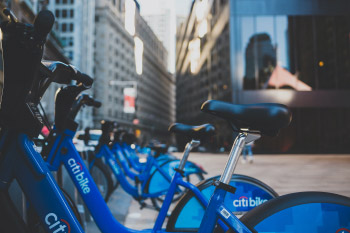
With its dense urban proximities, short distances and relatively flat terrain, New York City offers an ideal cycling environment, along with significant cycling challenges — including congested roadways with stop and go traffic, a sometimes unsympathetic regulatory environment, and streets with heavy pedestrian activity. The city has a large cycling population including utility cyclists such as delivery and messenger services, cycling clubs for recreational cyclists and, increasingly, commuters. An estimated 120,000 city residents bicycle on a typical day, and make 400,000 trips each day, equivalent to the number of the ten most popular bus routes in the city.The City Department of Transportation estimates there are an additional two in-line skaters for every cyclist in New York.
The city has 420 miles of bike lanes (as of 2005) including the Manhattan Waterfront Greenway and has in recent years expanded protected bike lanes on major thoroughfares and on bridges across the East River. More than 500 people annually work as bicycle rickshaw drivers, who in 2005 handled one million passengers. However, the City Council recently voted to curtail and license pedicab drivers, and will only allow 325 pedicab licenses. The city also annually presents the largest recreational cycling event in the United States, the Five Boro Bike Tour, in which 30,000 cyclists ride 42 miles (65 km) through the city's boroughs.
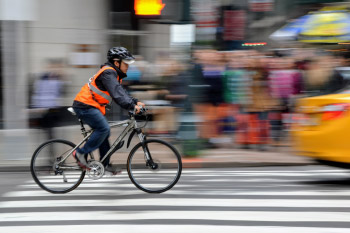
Bicycle paths connect most neighborhoods. Those in parks are Greenways, segregated from traffic. The Hudson River Greenway is so heavily used that it requires separation of the bikeway from pedestrians. Other parts of the Manhattan Waterfront Greenway and the Brooklyn-Queens Greenway are less continuously segregated. A Greenway runs through Pelham Bay Park and across the Bronx along Mosholu Parkway to Van Cortlandt Park where it connects to the South Country Trailway. Others run along the north shore of Jamaica Bay, the south shores of Little Neck Bay and Flushing Bay and other locations. About a hundred miles of painted lanes in streets connect to other parks and elsewhere, and the network is growing.
Some parks, including Central Park and Prospect Park, ban or restrict vehicles during certain weekday hours and all weekends to promote bicycling. Local bike shops in those neighborhoods offer rental bikes.
Several organizations, including Five Borough Bicycle Club and Bike New York, conduct tours every weekend. Most are day trips for no fee; some larger or overnight tours require payment. New York Cycle Club and others specialize in fitness and speed. Bicycle track races run most summer weekends in Kissena Park and elsewhere. Road races are held less frequently.
New York City Department of Transportation distributes a free and annually updated bike map through bike shops. The map shows each kind of route in a different color, and the locations and names of bike shops and points of touristic interest. You can download the New York City Cycling Map: http://www.nyc.gov/html/dot/html/trans_maps/bikeroute.html
These maps are informative, detailed, easy to read, and convenient for both recreational and commuter cyclists. The two-sided, full color map features a citywide overview on one side and a detailed borough map on the other.
A favorite of many city bikers is a tour around Central Park Drive, the winding 6.10 mile road that circles Central Park. Central Park has fewer cars passing through this year, thanks to new closures on the roadways. And while the Drive is regularly closed to cars, beware of the roller bladers and pedestrians, many of whom take no notice of bicyclists!
Another favorite is the wonderful bike path that encircles Manhattan, and you will be rewarded on an early Sunday morning ride by a beautiful sunrise, spectacular views of the New York harbor, the Hudson, Harlem and East Rivers, and the New Jersey Palisades, as well as relatively few fellow bikers. We highly recommend you try it!